RO/DI water is almost pure and has several uses in fishkeeping especially in marine aquariums. In freshwater aquariums, RO/DI water can be used routinely in auto-top-offs to prevent GH/KH accumulating when topping up due to evaporation. Carefully mixing London tap water with RO/DI reduces water hardness to better replicate some conditions found in the wild. This is especially important to encourage natural behaviours of many of the fish species we keep and increase spawning rates.
A downside to using RO/DI is the wastewater produced by the process. For every 1L of pure water produced, around 3L of high TDS water is “wasted”. Most places I’ve seen including our research labs simply dispose of the waste water down the drain, but at home this water can still be used for anything that doesn’t require low TDS like cleaning or watering plants.
Anyway, now that it’s set up I wonder why I didn’t have this before. It’s so convenient compared to carrying barrels of water from the aquarium shop (or from work ) and super easy to get going. You can plumb it into your main water line with a self piercing saddle valve, or attach to an outside hose tap like I did.
I bought mine from Vyair (UK) and they were super helpful in advising me on how to set up my unit. Mine is the RO-100M, currently using without a resin stage as I don’t need ultra pure water, but nice to have the option in case my needs change.
Possibly the most persistent myth in the aquarium hobby is the belief that the primary role of aquatic plants in the nitrogen cycle is to uptake nitrates. This has been repeated many times in older aquarium literature, but frustratingly many recently published sources (including books) incorrectly describe the role of plants in the nitrogen cycle. Understanding the “correct” nitrogen cycle in an aquarium has important implications to planning and maintaining a planted aquarium.
Nitrification
Nitrification Simplified
It is widely accepted that nitrification (converting harmful ammonia into nitrites and then nitrates) is carried out by nitrosomonas and nitrobacter, aerobic bacteria which are present in the soil and water attached to surfaces. The chemical process from converting ammonia into nitrites and then to nitrates releases energy, which the bacteria use for their metabolism.
The Role of Aquatic Plants in the Nitrogen Cycle
Aquatic plants require nitrogen to synthesise proteins, and can only use nitrogen in the form of ammonia. Indeed, plants can uptake nitrates, although they must convert nitrates into ammonia before they can use the nitrogen, a process which requires significant energy (the same amount of energy nitrifying bacteria have gained from the opposite reaction).
Experiments have shown that when given both ammonia and nitrates, aquatic plants will only uptake nitrates when ammonia has been depleted. When aquatic plants are given a choice between ammonia and nitrates, most aquatic plants vastly prefer the uptake of ammonia over nitrates even if this means “competing” with nitrifying bacteria.
Bacteria gain energy from nitrification, while plants must spend energy to obtain ammonia
Implications for the Home Aquarium
The uptake of ammonia by aquatic plants has practical implications for the aquarist. Most importantly, it de-emphasises the importance of a “biological” filter in aquaria with healthy fast growing plants. Although essential in aquariums without plants or with very little plant growth, many would argue that the biological filter is an unreliable way of dealing with ammonia in an aquarium. Nitrifying bacteria require plenty of flow and oxygen, can be sensitive to changes in water chemistry and their growth is very slow (division ~18 hours), during which time ammonia “spikes” can occur if there are any rapid changes to stocking or feeding levels. Nitrification also causes nitrate levels to increase and pH to fall, two reasons why frequent water changes are necessary in aquariums relying on the biological filter for ammonia control.
Using fast growing (especially emergent) plant growth in an aquarium is a considerably better way of controlling ammonia than a biological filter. Most aquatic plants prefer the uptake of ammonia directly compared to nitrates, and by competing with nitrifying bacteria, can prevent the buildup of nitrates in the aquarium. Competition with nitrifying bacteria for ammonia, rather than the direct uptake of nitrates may be the reason why aquariums with plants have lower nitrate levels than those relying on the biological filter. Acidification of aquarium water due to nitrification can also be prevented by using plants for ammonia control, as they compete with nitrifying bacteria for ammonia and consume H+ ions in photosynthesis.
There is something quite rewarding about setting up a biotope tank. With high lighting, dosing and CO2 readily available to more everyday hobbyists, it is tempting to go the purely artistic route and select plants, fish and decor for our tanks that look nice and have aesthetic appeal together.
But sometimes, it’s nice to limit choice and select flora and fauna originating from a specific environment. A biotope aquarium can be like having a slice of natural habitat in your home, and more often than not the fish display natural behaviours and colours rarely seen in more “ornamental” tanks.
I think the Amazon blackwater biotope is the easiest to set up and maintain, especially as it’s not dependent on submerged plant growth which many beginner hobbyists struggle with. The Amazon blackwater biotope is characterised by slow flowing dark, tannin-stained water, little to no submerged plant growth a substrate covered with leaf litter at varying stages of decomposition. Fish species are varied, including many species of tetras, corydoras and otocinclus.
Hardscape and Fauna
Keeping the layout simple, I used a shallow layer of sand covered with catappa leaves and a piece of driftwood. I decided on a shoal of cardinal tetras for this tank, an obvious choice for an Amazon biotope. They acclimated extremely well and coloured up fully within an hour of introduction to the tank. The Otocinclus I added were also quick to acclimate to the tank, and within hours they were swimming around and feeding among the leaf litter.
Cardinal Tetra
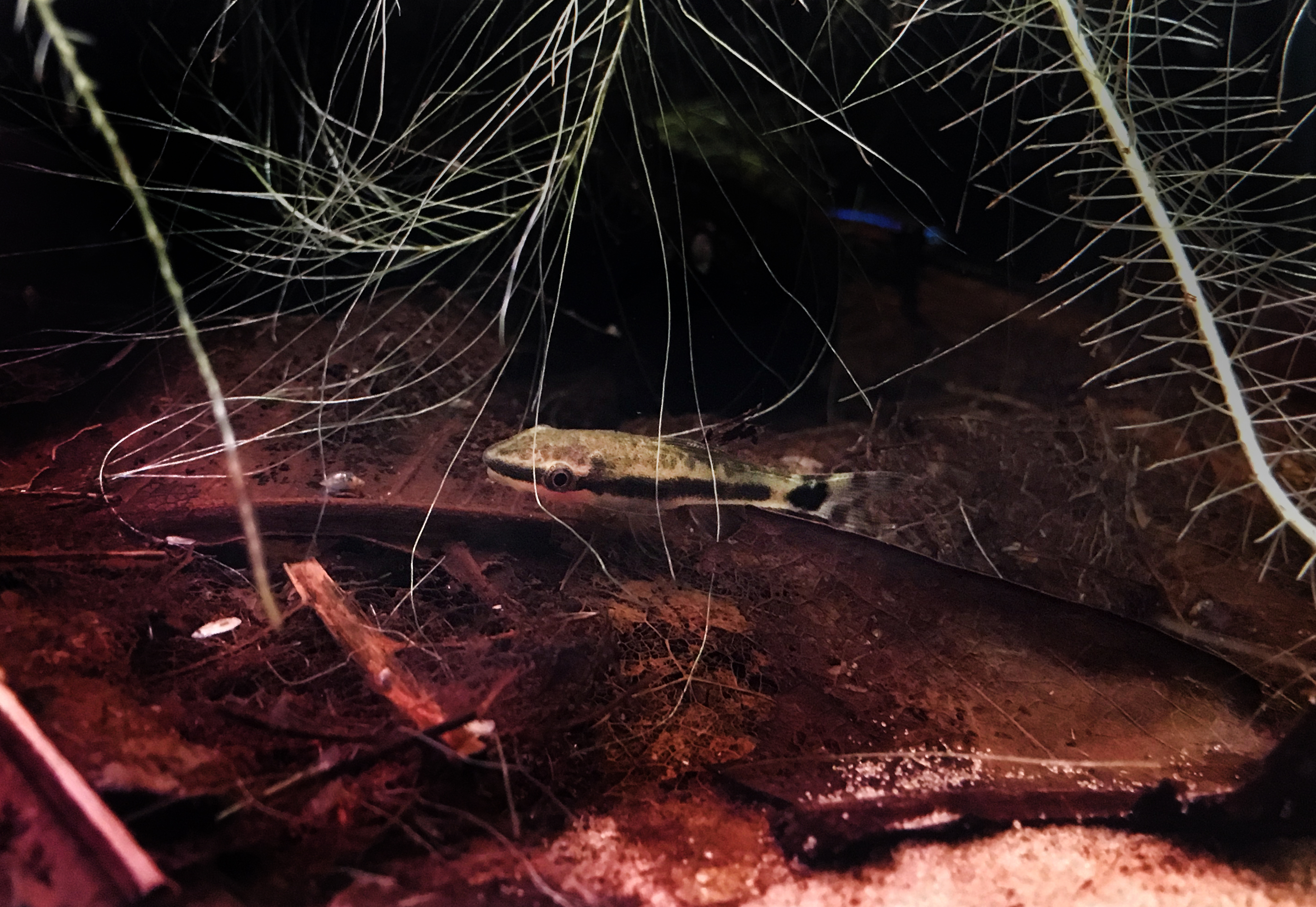
Otocinclus
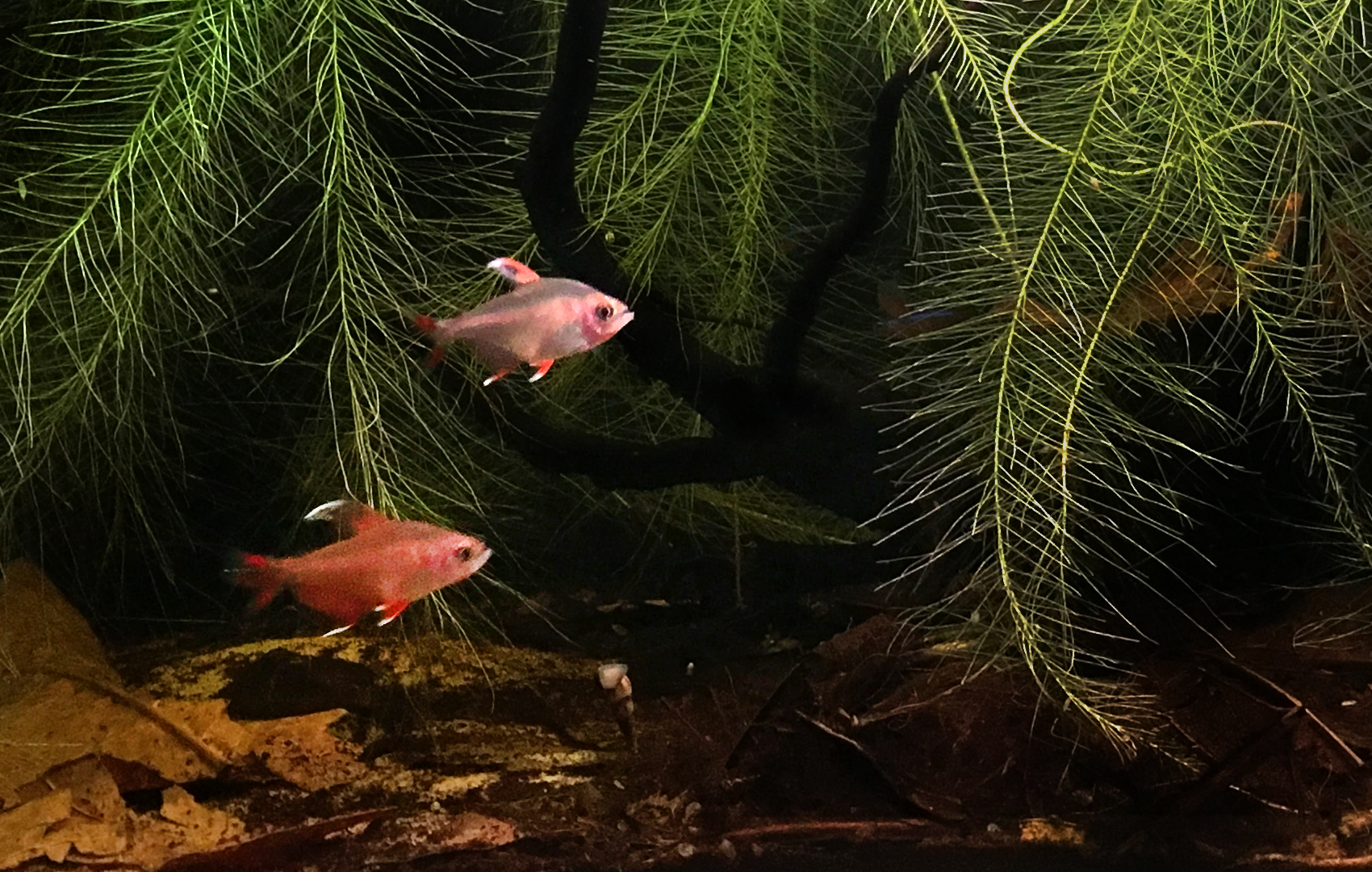
It took me a while to decide which “showcase fish” to add to the tank, as many Amazon biotope aquariums I’ve seen either contained a huge shoal of tetras, Discus or Angelfish. None of these would be suitable for the size of my tank, so I decided to add a small group of Bentosi’s Tetra, a deep bodied species of Tetra with very interesting white-tipped finnage. Like the other fish, the Bentosi’s acclimated much faster than I’m used to and the following morning they were showing breeding behaviours among the roots of floating plants.
Bentosi Tetra
I also added various snails and cherry shrimp, although not specifically from the amazon, their versatility and readiness to breed make them extremely useful in any tank.
Water Conditions
I’m using standard dechlorinated tap water in this tank with a pH of 7.4, although decaying leaf litter tends to reduce pH to 6.5. The leaf litter is also responsible for staining the water a brown colour, mimicking the natural habitat. Cardinal tetras require a temperature of ~26-28ºC, which is higher than most other tropical fish which do well at 24ºC. I used an acetate lid to reduce heat and evaporative loss, without which I’d lose almost 2 litres a week. The lid also has the effect of increasing the heat and humidity of the air surrounding the floating plants, which may be beneficial to plant growth. I’m dosing APF’s Trace/Macro EI solution, although only 1/4 of the recommended dose and adjusting according to the condition of duckweed (or “duckweed index”). I think that any old aquarium fertiliser providing trace elements and potassium would work here, as nitrates and phosphates are quite high in London tap water anyway.
Plants
I decided to use the floating plants water lettuce (Pistia), duckweed (Lemma), Salvinia and Amazon Frogbit in this tank, as they are commonly found among the banks of the Amazon river. In the aquarium, they serve a useful function of biological filtration, drastically reducing the need for a bacterial based biological filter to remove ammonium. This is advantageous as nitrifying bacterial filters take time to develop, lower pH as they work and produce nitrates which accumulate over time (nitrate creep). Plants absorb ammonium from fish waste directly, and use it to produce their own biomass. In this way, the hobbyist can “remove” nitrogen from the aquarium simply by pruning plants. The roots of water lettuce and duckweed also provide a huge surface area and substrates for bacterial colonisation, and it is likely that nitrifying bacteria are also present here, although I suspect much of the ammonium uptake is by the plants themselves.
I find that my heavily planted tanks don’t suffer from nitrate “creep” at all, unlike my lightly planted goldfish tank which relies on a bacterial filter for nitrification and requires weekly water changes to keep nitrates in check.
I found that the Pistia got quite large (30cm across) despite being indoors, which I can attribute to either the high humidity under the acrylic sheet or the high lighting from the LEDs (more on this below). After a certain size, Pistia starts producing small white flowers about 10mm long from the centre of the rosette. In my other tanks exposed to “room air” and with lighting suspended higher over the tank, the water lettuce would only grow to about 7cm across and produce no visible flowers at all.
Water Lettuce (Pistia) Flower
Lighting
Relying to plants for biological filtration requires rampant healthy growth. A straggly piece of elodea probably won’t do much to reduce ammonium levels. To encourage fast plant growth, I’m using two TMC Aquaray 400 tiles at 12W each mounted about 20cm above the tank, which should provide considerable PAR at the surface and mimic the tropical sun. Normally for a tank this small I would not run these lights over 40% unless I knew I could keep CO2 levels stable enough to prevent algae growth, but the dense shade provided by the floating plants as well as the tannin stained water prevent excessive light from reaching the substrate or front glass, and I never have problems with algae.
One of the factors that makes a blackwater biotope tank so easy is that algae growth is low. You can throw tons of light onto the tank to encourage fast growing floating plants to out-compete algae, and the tannin stained water prevents excessive light from reaching submerged surfaces.
Circulation
Whichever method of circulation I used in this tank, I wanted it to be very gentle to represent the slow moving blackwater habitats. Slow water movement also allows the leaf litter to settle nicely and not get bunched up in a corner of the tank. Originally, I decided to use an airstone in the corner to provide some water movement, however this produced tiny droplets which covered the leaves of Pistia with tannins and biofilm. The airstone was also very loud which was a no-no for my bedroom.
The tank is now circulated by a fairly cheap 100l/h internal filter, with a spraybar attachment to distribute the flow more evenly. A simple coarse sponge is used in the media compartment, simply to prevent snails and debris entering the impeller shaft.
Full Tank Shot
I suppose the main reason for this post was to demonstrate how easy it is to set up and maintain a biotope aquarium like this. With the availability of CO2, nutrient dosing and ever more complicated filtration and equipment, it is easy to get caught in the high-tech trap. This biotope is the opposite, with only the most basic of equipment, low running costs and minimal maintenance. Oh and lots of leaf litter and happy fish.




 ATR93
ATR93 