
I’ve always been a massive fan of IEMs ever since my first pair of Shure SE315’s I bought a decade ago, and still use my second-hand SE846’s on a daily basis. The SE846 retains Shure’s signature slightly mid-forward/relaxed treble sound signature but is also able to deliver subwoofer-like performance when tracks call for it. I’ve yet to try another IEM or even full sized headphone (maybe apart from the Nuraphones) which is able to deliver such a visceral bass presence without muddying up the mid range.
The removal of the 3.5mm headphone jack from recent phones led to a widespread move to bluetooth audio and increased availability of almost perceptually lossless bluetooth audio codecs. Being utterly in love with the SE846’s sound and form factor, I naturally explored newer options (some borrowed, some bought) to use my now 6 year old IEMs with modern sources.
The SE846 uses a standard MMCX connector on each IEM which is a godsend, allowing the user to replace the cable (which is the part most likely to fail) independently of the driver. The particular MMCX implementation of Shure’s IEMs (and most other makes on the market) allows for third party cable solutions. Thankfully, the MMCX standard is widespread enough that there are plenty of bluetooth adapters available on the market. I have tried three solutions over the last couple of months which I’ll discuss here:
- Shure RMCE-BT2 (MMCX Bluetooth cable)
- FiiO BTR5 (Bluetooth DAC)
- TRN BT20S (True wireless adapter)
Sources: iPhone (AAC), Mac (APTX), Samsung Galaxy S10 (to test LDAC on FiiO BTR5)
Lossless M4A music library
Shure RMCE-BT2 (~£108)

Apparently one of the better bluetooth MMCX cables, supporting Bluetooth 5.0 along with bluetooth audio codecs including SBC, AAC, APTX, APTX-HD and APTX-LL. The Shure RMCE-BT2 is slightly larger than other bluetooth cable designs due to the battery and amp “module” which both wires emerge from. According to Shure, the reason for this was due to the separation of the Bluetooth audio chipset and DAC which allows Shure to use a higher quality DAC/amp as well as to separate components to prevent noise. The BT2 cable also has a mic and buttons for calls/music controls which feel fairly standard and comparable to cheap-o bluetooth cables available on Amazon.
Driving the SE846’s with the BT2, I can’t fault the sound quality of this cable. For testing at home, I listened to my lossless library over Bluetooth AAC (iPhone) and APTX (Mac). Some may complain of the lack of LDAC support (the highest quality Bluetooth codec available) but honestly the difference between LDAC and other advanced bluetooth codecs is negligible to me. The noise floor of the BT2 is also excellent, however the cable-based implementation and the slightly chunky design results in cable microphonics while walking or moving. The BT2 also has a fairly low output level (volume) which isn’t a problem for low impedance balanced armature IEMs but can be a problem with harder to drive units. The price of the BT2 is also well above comparable solutions and I personally wouldn’t spend this much with so many alternative options available, even if they don’t separate out the Bluetooth chipset and DAC like the BT2 does.
Fiio BTR5 (~£140)

The FiiO BTR5 is a super versatile bluetooth/USB-C DAC supporting all major bluetooth audio codecs and a wide range of configurations including 3.5mm and 2.5mm balanced audio outputs. In terms of pure sound quality, the BTR5 driven from USB-C input is probably the most transparent DAC/Amp solution I have and the output is clean and noise-free even for sensitive balanced armature IEMs. The BTR5 can also be controlled either with on-device controls or the FiiO Music App which allows the user to save EQ profiles onto the device, change basic functions like power-off timer, whether the device charges when plugged in and even low-pass filter/harmonic compensation implementation which is nice to have but probably far too technical for most users including me.
As for my personal use case, the BTR5 is great for listening sessions when I have the luxury of not travelling/doing something, however for everyday usage, the fact that I have to plug a cable in and have yet another device in my pocket isn’t great. Being a cabled solution, microphonics/tangling is an issue and while the device/cable solution is more portable than an over-ear headphone, the setup is not convenient to use everyday. The BTR5 is the most expensive solution I have, but its versatility, sound quality and ability to drive sensitive IEMS all the way up to high impedance over-ears makes it handy to have around.
TRN BT20S (~£50)
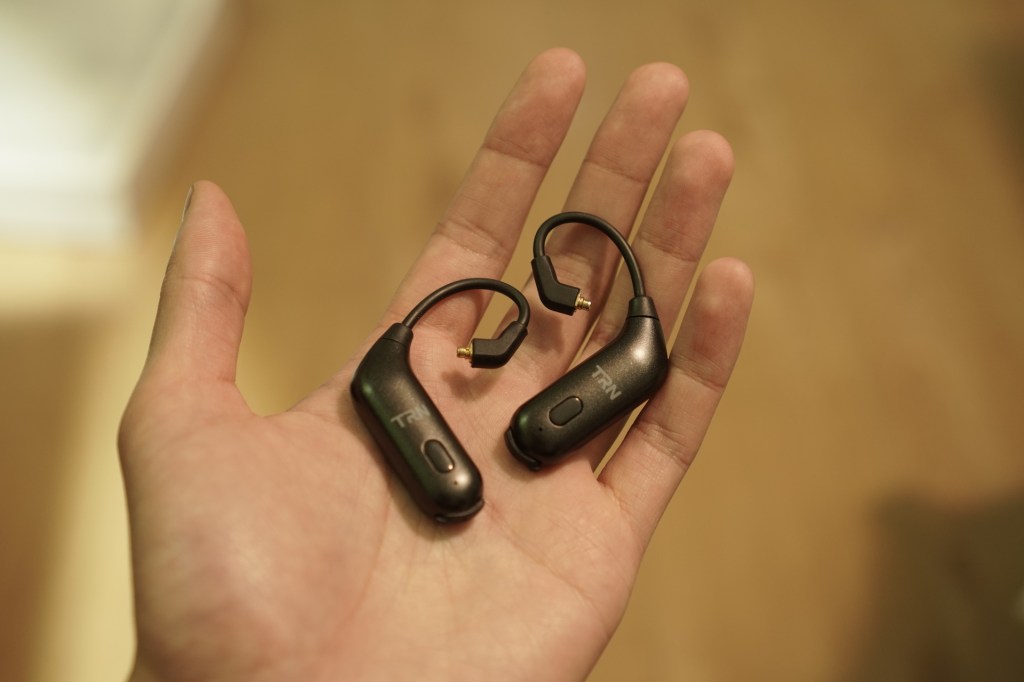
The TRN BT20S (not to be confused with the older BT20 which uses a completely different chipset/amp) is a true-wireless MMCX adapter supporting Bluetooth 5.0 and the SBC, AAC and APTX codecs. Unlike other true-true-wireless earbuds/IEMs, the BT20S doesn’t come with a charging case so charging is handled by a micro-USB port on each adapter. A dual-head micro-USB cable is provided, and while it’s not the most elegant solution, it is fully independent of a proprietary case for charging. USB-C would have been nice, but I’m currently just thankful that such a device exists in the first place.
Right off the bat, the BT20S is both the worst and best sounding solution of the three that I’ve tried.
The biggest problem is the noise floor/hiss, which is painfully obvious on the low impedance SE846 and also a problem on other Shure IEMs. During listening, the hiss doesn’t bother me too much as it’s masked by the sound of whatever is playing, however it is more noticeable in classical music or songs with a quiet sections or wide dynamic range. As for the sound itself, my SE846’s sound every so slightly brighter with the BT20S compared to my FiiO BTR5 while at the same time, details and timbre of instruments were slightly more difficult to resolve. This was only apparent when comparing the two directly, and in everyday use the sound quality of the BT20S was great.
Despite being the weakest solution I tried in terms of sound quality, the BT20S is the current daily driver for my SE846s. It was only when I started using the BT20S did I realise how much noise/rustling was picked up by other IEM cables I’ve been using over the years. Being on-ear and devoid of trailing cables, the isolating effect of the BT20S is hard to explain but contributes to the IEMs feeling like they just disappear leaving you surrounded by music. Most importantly, the lower noise transmission from walking/movement allows for a comfortable listening experience at lower volume levels.
The future
The perfect MMCX solution (imo) would be something like the BT20S with the noise floor and audio quality of the FiiO BTR5, possibly with longer battery life and as a bonus, an implementation of noise cancelling/sound passthrough feature frequently seen on over ear headphones. FiiO has a variant of the BT20S (the UTWS1) which claims to improve the noise floor issue, however it is still not recommended for sensitive IEMs. Hopefully the next iteration of the BT20S will at least resolve the noise floor issue and also bring USB-C charging, but for now the BT20S are good enough.
 ATR93
ATR93 
Andy have you tried the Tru wireless adapters?
Hi Rei, yes in fact that’s what I’m currently using :) I’m really happy with them so far, no major complaints for sound quality or comfort. I’ll update this post soon
Hi Andy. Thanks for the reply. My music player died and the company doesn’t make music players anymore😢. I’m thinking should I just get the tru wireless and forget about a dedicated music player. What are you using yours with? From a fellow Viet brother.