
Possibly the most persistent myth in the aquarium hobby is the belief that the primary role of aquatic plants in the nitrogen cycle is to uptake nitrates. This has been repeated many times in older aquarium literature, but frustratingly many recently published sources (including books) incorrectly describe the role of plants in the nitrogen cycle. Understanding the “correct” nitrogen cycle in an aquarium has important implications to planning and maintaining a planted aquarium.
Nitrification
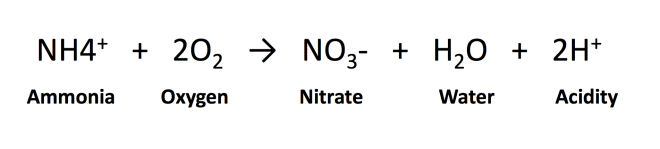
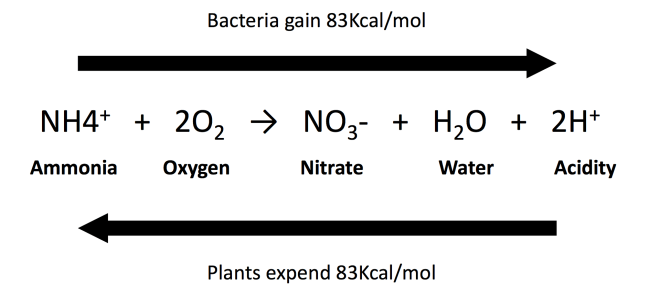
It is widely accepted that nitrification (converting harmful ammonia into nitrites and then nitrates) is carried out by nitrosomonas and nitrobacter, aerobic bacteria which are present in the soil and water attached to surfaces. The chemical process from converting ammonia into nitrites and then to nitrates releases energy, which the bacteria use for their metabolism.
The Role of Aquatic Plants in the Nitrogen Cycle
Aquatic plants require nitrogen to synthesise proteins, and can only use nitrogen in the form of ammonia. Indeed, plants can uptake nitrates, although they must convert nitrates into ammonia before they can use the nitrogen, a process which requires significant energy (the same amount of energy nitrifying bacteria have gained from the opposite reaction).
Experiments have shown that when given both ammonia and nitrates, aquatic plants will only uptake nitrates when ammonia has been depleted. When aquatic plants are given a choice between ammonia and nitrates, most aquatic plants vastly prefer the uptake of ammonia over nitrates even if this means “competing” with nitrifying bacteria.
Implications for the Home Aquarium
The uptake of ammonia by aquatic plants has practical implications for the aquarist. Most importantly, it de-emphasises the importance of a “biological” filter in aquaria with healthy fast growing plants. Although essential in aquariums without plants or with very little plant growth, many would argue that the biological filter is an unreliable way of dealing with ammonia in an aquarium. Nitrifying bacteria require plenty of flow and oxygen, can be sensitive to changes in water chemistry and their growth is very slow (division ~18 hours), during which time ammonia “spikes” can occur if there are any rapid changes to stocking or feeding levels. Nitrification also causes nitrate levels to increase and pH to fall, two reasons why frequent water changes are necessary in aquariums relying on the biological filter for ammonia control.
Using fast growing (especially emergent) plant growth in an aquarium is a considerably better way of controlling ammonia than a biological filter. Most aquatic plants prefer the uptake of ammonia directly compared to nitrates, and by competing with nitrifying bacteria, can prevent the buildup of nitrates in the aquarium. Competition with nitrifying bacteria for ammonia, rather than the direct uptake of nitrates may be the reason why aquariums with plants have lower nitrate levels than those relying on the biological filter. Acidification of aquarium water due to nitrification can also be prevented by using plants for ammonia control, as they compete with nitrifying bacteria for ammonia and consume H+ ions in photosynthesis.
As Diana Walstad said in her book, Ecology of the Planted Aquarium, “let the plants do the work for you!”.

 ATR93
ATR93 